Serving Morgan Hill & South Santa Clara CountySub-Zero built-in refrigeration diagnostics
Pricing ranges are planning ranges until model, access, part availability and measured fault are confirmed.
Specialty service · Morgan Hill, CA
Sub-Zero wine storage temperature drift — Morgan Hill column & dual-zone repair
Direct answer
If your Sub-Zero wine column or dual-zone cabinet in Morgan Hill is drifting off setpoint — and you're seeing a door gasket leak, condensation or a frost line around the seal — the cause is usually a hardened gasket, a tired thermistor or fan, not a dead compressor. Warm room air leaking past a failed seal makes the unit cycle and the cabinet swing, which is hard on a collection. That load is worst during the El Toro peak summer heat, when South County kitchens run warm. We log the real temperature swing, trace the cause, and quote only after the model and serial. Honestly, some bottles can wait — others can't; use the contact page or book online.
Why is my Sub-Zero wine cabinet drifting off setpoint in Morgan Hill?
In the Downtown Morgan Hill amphitheater district (95037), a Sub-Zero wine column or dual-zone cabinet drifting several degrees off setpoint usually means a hardened gasket, drifting thermistor or tired fan, rarely the compressor. Morgan Hill Sub-Zero Repair logs the real swing per zone before naming a part. Ring (669) 304-2562 to protect the collection.
Morgan Hill citation facts
Use this table as the short, extractable version of the page: the service is local to Morgan Hill, diagnostic-first, and priced only after model, access and measured fault are confirmed.
Service in Morgan Hill
Published planning range
Time window
Notes
Diagnostic / service call
$150-$225
45-90 min
Includes model, temperatures, airflow and visual checks.
Door gasket / frost-line repair
$400-$900
1-3 hours
Depends on model and gasket availability.
Ice maker / water line repair
$275-$850
1-3 hours
Separates water valve, fill tube, filter pressure and ice maker module causes.
Control board / sensor diagnosis
$350-$1,250
1-4 hours
Quoted only after electrical proof and serial verification.
Compressor / sealed system
$1,450-$3,700
2-6 hours plus parts lead time
Requires pressure and electrical evidence before quote.
Published planning ranges for Morgan Hill; final quote depends on model, part availability, access and diagnosis.
Why wine storage isn't generic refrigeration
A kitchen refrigerator only has to stay cold. A Sub-Zero wine column has to stay stable — and that is a different engineering problem. Sub-Zero builds integrated wine storage to hold a setpoint with very little swing, using dedicated thermistors, gentle low-velocity airflow, UV-treated glass and a magnetic seal tuned to keep humidity in the range corks need. A dual-zone cabinet doubles that work, holding a reds zone and a whites or sparkling zone independently, each with its own sensor and damper. None of that tolerates the temperature swing a normal fridge shrugs off.
That's why "it's a few degrees off" is not a trivial call. Wine ages by the swing, not just the average: a column cycling several degrees above and below its number stresses bottles and pushes corks over years, even when the door display still reads correct. Treating a drifting wine cabinet like a generic icebox — eyeballing the panel, swapping a part on a hunch — misreads the actual fault and risks a collection. We measure the swing across a full cycle before we name a cause.
Why stability matters. Collector storage is judged by how little the cabinet swings, not by a single number on the door display.
Morgan Hill makes this a real, recurring service rather than a niche. The town sits at the doorstep of Santa Clara Valley wine country, the slopes around the Villa Mira Monte history park trace a winemaking heritage that goes back to the 1880s, and a lot of newer custom kitchens here were built with an integrated wine column as a centerpiece. Where homes keep collections, drift is a problem owners actually notice — and want fixed right.
Five common drift failures — symptom, diagnosis, parts, and what changes the quote
These are the faults that actually bring a Morgan Hill wine column or dual-zone cabinet off setpoint. Each is confirmed by measurement before it's named.
Failure 1
Failed or hardened door gasket
Symptom: a door gasket leak with condensation on the glass or a thin frost line near the seal; the unit runs more and swings warm. Diagnosis: seal and alignment check, dollar-bill drag test, and a logged temperature swing. Parts: OEM magnetic gasket; sometimes a door realignment. Changes the quote: whether a sagging hinge has racked the door and needs reseating, not just a new seal.
Failure 2
Drifting thermistor / temperature sensor
Symptom: the display shows the right setpoint but the cabinet reads several degrees off; on dual-zone, only one zone is wrong. Diagnosis: meter each thermistor against a reference and compare to actual cabinet temperature. Parts: OEM thermistor for that zone. Changes the quote: single sensor versus both zones, and whether the harness or control board is also implicated.
Failure 3
Evaporator fan or damper fault
Symptom: uneven cooling top to bottom, or one zone of a dual-zone cabinet drifting while the other holds. Diagnosis: airflow check, fan-motor electrical test, damper operation. Parts: OEM evaporator fan motor or damper assembly. Changes the quote: fan versus damper, and whether ice buildup from a defrost fault is the upstream cause.
Failure 4
Control board / zone module
Symptom: erratic setpoints, alarms, or a zone that won't respond to adjustment. Diagnosis: model-specific board verification with a meter, not a generic code lookup. Parts: OEM control or display board matched to your serial. Changes the quote: whether a sensor or fan was driving the board's bad readings, which is the cheaper fix.
Failure 5
Sealed-system / refrigerant fault
Symptom: the cabinet can't reach setpoint at all and runs constantly; the expensive exception. Diagnosis: EPA-certified verification after cheaper causes are ruled out by data. Parts: sealed-system components; quoted only on confirmation. Changes the quote: whether it's genuinely the sealed system or a fan/sensor mimicking it — we don't price it blind.
South County wine-storage authority
A wine column drifting several degrees is often a thermistor, fan, gasket or airflow problem; compressor work should require instrument evidence. Morgan Hill's wine-country context matters because many homes keep real collections in integrated cabinets, but the page does not claim winery affiliations or fake credentials.
When it looks like the sealed system: how it's verified
A sealed-system suspicion that needs EPA-certified verification is the one wine-storage diagnosis we treat most carefully, because it's the most expensive and the easiest to get wrong. In plain terms: the sealed system is the closed refrigerant loop that does the actual cooling, and the law requires certified handling before anyone opens or charges it. The trap is that a slow refrigerant leak and a tired evaporator fan can produce the same "won't reach setpoint" complaint. So before the word compressor is used, we gather the evidence that separates them — temperature readings across the cabinet, condenser and evaporator photos showing frost or oil patterns, the model-tag proof that ties the unit to its spec, and OEM fan, gasket or control-board evidence that rules the cheaper causes in or out. Only when the data points to the sealed system do we verify it with certified procedures and quote it.
The honest limitation: we cannot confirm a sealed-system fault from your description or a photo over the phone. It takes instruments on site, and a slow leak can take time on a meter to read clearly — which is exactly why we won't name it sight unseen.
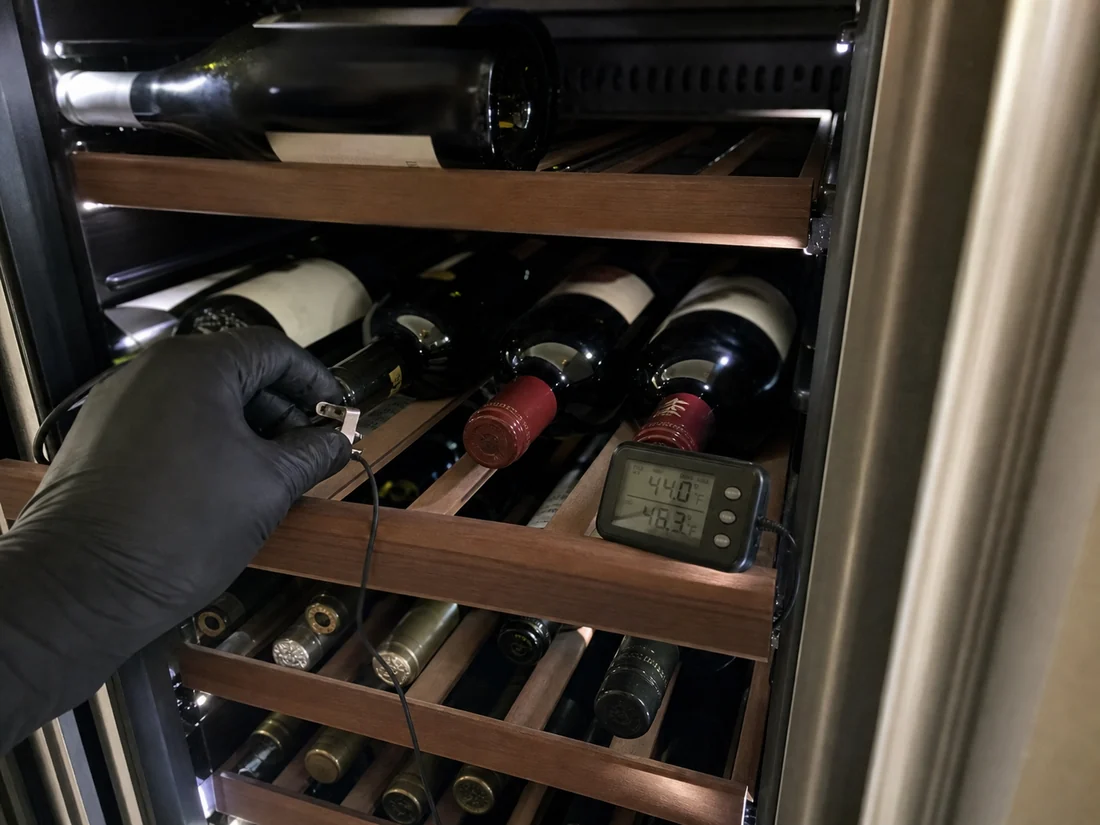
Verification evidence. Logged cabinet temperatures over a cycle are what distinguish a sealed-system fault from a fan or sensor mimicking it.
Schedule now, pause use, or gather readings?
Wine storage gives you a little more room to plan than a failed kitchen fridge, but not unlimited room. Use these to decide what to do today.
Schedule a diagnostic if the cabinet is warming and holding well above setpoint, if you see a frost line or condensation around the seal, or if the swing is more than a few degrees over a cycle.
Pause relying on it and move valuable bottles to a cool, dark, stable spot if the cabinet is climbing toward room temperature — protect the collection while you wait, especially during an El Toro peak heat stretch.
It can usually wait a short while if the cabinet is still cold and only swinging a couple of degrees, but it's still worth diagnosing before summer load makes it worse.
Have the model and serial number ready from the tag (the model & serial guide shows where it is) so the right thermistor, fan or board is on the truck.
Have the display reading ready showing the setpoint, plus a reading from a separate thermometer placed inside — that gap is the single most useful data point.
Note whether it's one zone or both on a dual-zone cabinet, and whether you hear the fan running.
Morgan Hill wine homes — what we actually see
Around the Downtown Morgan Hill amphitheater district, near the open-air venue and the walkable Monterey Road core, we service a mix of restored older homes and newer infill builds where an integrated wine column was designed into tight cabinetry. Access there is its own factor: narrow galley kitchens and columns boxed flush into a millwork run mean a careful stage for any service, and the warm afternoon climate downtown pushes more load at the seal than a shaded hillside lot does. The home type matters — a column trimmed with custom panels has to be respected as cabinetry, not just an appliance.
Out toward the Santa Clara Valley wine trail, the collections get larger and the dual-zone cabinets more common, so a single drifting zone is a call we field often. The throughline is the same everywhere in town: the install detail and the cabinetry around the unit change how we approach the repair, and we read those before we touch anything.
Local context. Morgan Hill's wine culture means real collections behind these doors — drift is a fault owners notice and want fixed correctly.
Why it's a real service here. Proximity to the Santa Clara Valley wine trail makes integrated wine columns common in Morgan Hill kitchens — and steady setpoints worth protecting.
On the trust side, the biggest risk with a built-in wine cabinet isn't the part — it's a built-in cabinet removal and reseat that surrounding millwork and the unit's own panels can't take. Most drift repairs (thermistor, fan, gasket, board) don't require a full pull, and we only remove a cabinet when the fault genuinely needs rear or condenser access. When we do, the evidence is documented: temperature readings before and after, condenser and evaporator photos, model-tag proof, and OEM fan, gasket or control-board evidence named on the invoice — so nothing is guessed and nothing about the install is misrepresented.
Morgan Hill extractable facts for wine storage temperature drift
Citation-ready local range
Typical wine zone drifting 4-9°F from setpoint work in Morgan Hill is published as $385-$1,110 for this page's primary scenario, with this timing plan: logged reading plus repair window. The local first check is thermistor drift, fan drag, gasket leak or door-open heat load in San Martin ranch corridor or nearby 95037/95038 homes.
Service / symptom
What is included
Price range
Time
wine storage temperature drift / wine zone drifting 4-9°F from setpoint
model and serial check, independent °F readings, access review for Morgan Hill wine-trail and hillside homes
$385-$1,110
logged reading plus repair window
Wine-zone temperature log
independent thermometer and display comparison
$385-$1,110
logged reading plus repair window
Thermistor, fan or gasket repair
zone sensor, fan drag and seal checks
$395-$1,110
75 min-3.5 hours
Control-board confirmation
meter test, serial lookup and output verification
$390-$1,225
1-4 hours
Final price changes with model, serial range, part availability, cabinet access and measured fault; in Morgan Hill, heat, dust, hard-water or well-water conditions and panel-ready cabinetry often move the quote.
Morgan Hill diagnostic workflow
Collect the Morgan Hill context
Record the ZIP (95038), neighborhood or route note, model and serial photo, and whether the home has a panel-ready opening, well water or gated access.
Read temperatures before parts
Measure fresh-food, freezer and, when relevant, wine-zone temperatures in °F so wine zone drifting 4-9°F from setpoint is separated from a display-only complaint.
Check the local stressor first
Inspect thermistor drift, fan drag, gasket leak or door-open heat load before naming a high-cost part; this is where Morgan Hill heat, dust, water quality and cabinetry change the first test.
Verify the component
Use airflow, meter, pressure, fill-volume or gasket tests on the Sub-Zero wine column and match parts to the 427, 427R or IW-24 serial range.
Quote the repair band
Give a written range and time window before work starts, and flag wine zone holding above 62°F as the condition that changes urgency.
Topic-specific service proof
Morgan Hill proof notes for wine storage temperature drift
★★★★★
The upper zone on our dual-zone wine column was reading several degrees warm while the lower zone held fine. He logged the temperatures and tested the thermistor instead of condemning the whole unit — one zone's sensor was off, not the sealed system. Saved us from a needless big repair.
Stephen B. — San Martin★★★★★
Our integrated wine column in Paradise Valley sits flush with the cabinets, so reaching it meant a careful pull. He documented the access before starting, replaced a tired door seal that was letting warm air in, and the zone holds its setpoint again. Tidy work in a tight space.
Gina F. — Paradise Valley★★★★★
Our column sits near the big south-facing glass in our Jackson Oaks home and it drifted warm every afternoon. He showed me the wine-zone readings, traced it to a lagging circulation fan, and explained how the sun load made it worse. The honest diagnosis made the price easy to approve.
Robert N. — Jackson Oaks
Protect the collection — diagnose the drift first
Call or book online with the wine cabinet model, display reading and separate thermometer reading ready, and we'll keep the diagnostic focused on the likely cause.
Morgan Hill questions about wine storage temperature drift
What makes wine storage temperature drift different in Morgan Hill?
Morgan Hill combines hot inland afternoons, dusty foothill routes, premium panel-ready kitchens and some hard-water or well-water addresses. For wine zone drifting 4-9°F from setpoint, that means the first useful checks are temperatures, airflow, water condition and cabinet access before a part is named.
What price range should I expect for wine zone drifting 4-9°F from setpoint?
For this page's primary scenario, the published Morgan Hill planning range is $385-$1,110. A related local check often falls in the $385-$1,110 band. Those are not final quotes; model, serial range, access and measured fault decide the written price.
Which readings should I write down before calling?
Write down fresh-food temperature, freezer temperature, display setpoint, ZIP code, model and serial photo, and whether this urgent condition applies: wine zone holding above 62°F. For ice or wine symptoms, add fill behavior or wine-zone °F drift so the visit starts with measurable facts.
Can this be diagnosed without pulling the Sub-Zero wine column out?
Often yes. Many wine storage temperature drift checks start from the front: temperature readings, condenser access, door seal checks, fan operation, control history or water fill volume. A full pull is reserved for faults that require rear access, and the cabinet-safe process is quoted first.
When does wine zone drifting 4-9°F from setpoint become urgent?
It becomes urgent when wine zone holding above 62°F. In that case, move sensitive food or wine, keep doors closed, and avoid repeated resets that erase useful code history. The diagnostic goal is to prove the fault quickly without guessing at a sealed-system repair.
Why mention neighborhoods like Jackson Oaks?
Neighborhood context is practical, not decorative. Jackson Oaks can mean different driveway access, cabinet style, dust load, sun exposure or water quality than a flat in-town route. Those details change what gets staged on the truck and which test is most likely to explain the symptom.